
How to Play


TOTYM Rules (v2.0) - Updated 2026-07-22
1. Game Overview
Summary
In TOTYM, each player controls a single active creature at a time. On your turn, you draw from your Temple, and build totems on either side of your creature with a combination of tarot cards that create effects or disrupt opponents, and worship cards, which are played face-down. Worship cards may be real or bluffed, and opponents can challenge a completed totem by playing an Imposter card if they believe it is built on false worship.
When a totem meets its worship requirements and is successfully locked, it brings the creature closer to ascension. Once both sides of a creature are locked, the creature ascends and scores a point.
Players must balance deception, timing, and disruption while preventing opponents from completing their own totems. The game continues until a player ascends three creatures or until all other players are eliminated.
Win Conditions
A player wins the game immediately if they ascend three creatures.
Alternatively, a player wins if all other players have been eliminated. A player who is forced to draw cards but cannot is immediately eliminated from the game.
Core Terminology
- Temple: Your draw pile.
- Ruins: Your discard pile.
- Chapel: Your inactive creature pile.
Card Types

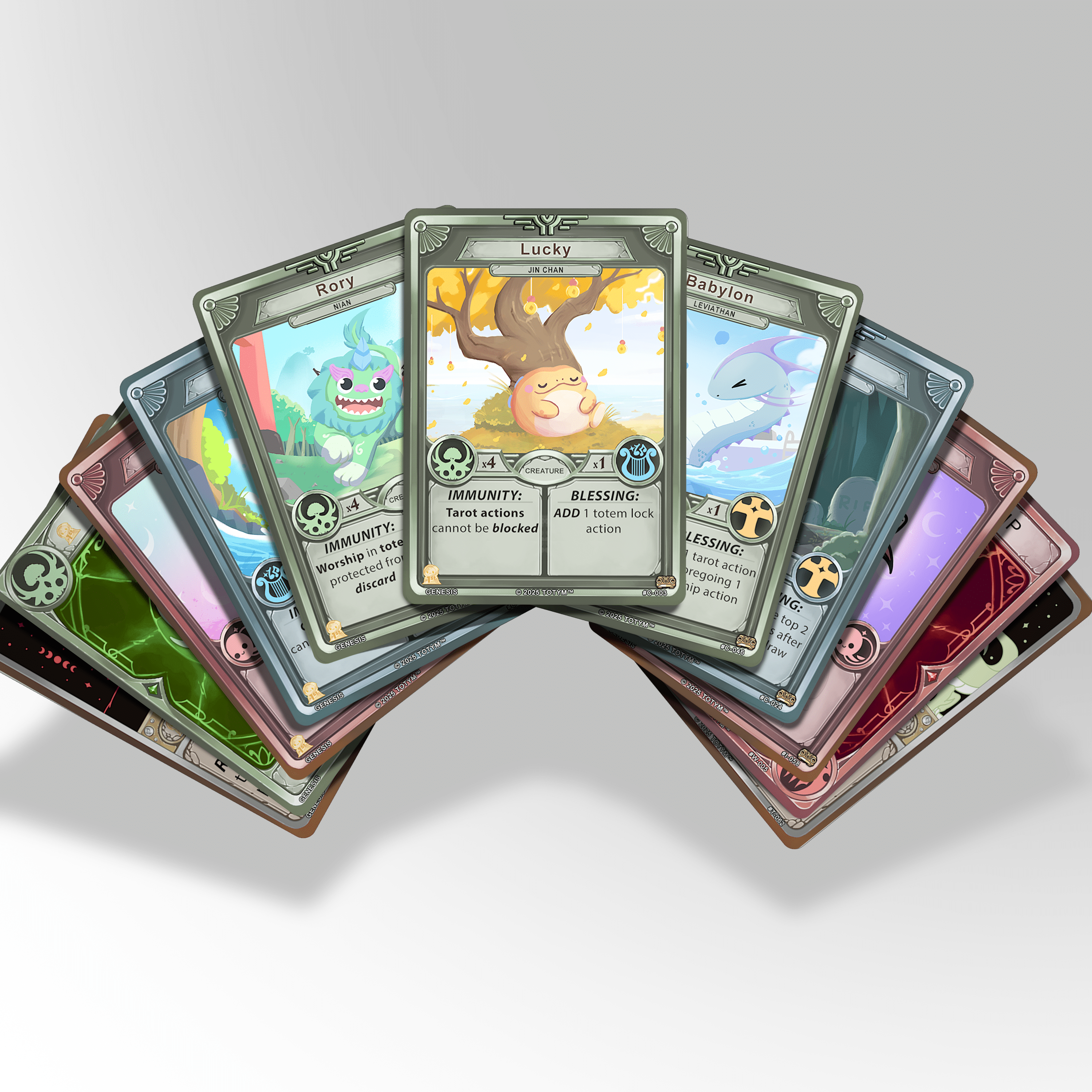
Creature Cards: Creatures have their own worship requirements, blessings, and immunities. Creatures are ascended during the game to score points.
Worship Cards: Worship cards are placed into totems to meet a creature’s worship requirement.
Tarot Cards: Tarot cards create effects, actions, and disruptions. Tarot cards include Major Arcana (non-suits) and Minor Arcana (suits).
Imposter Cards: Imposter cards are used to challenge locked totems when you feel an opponent is bluffing.
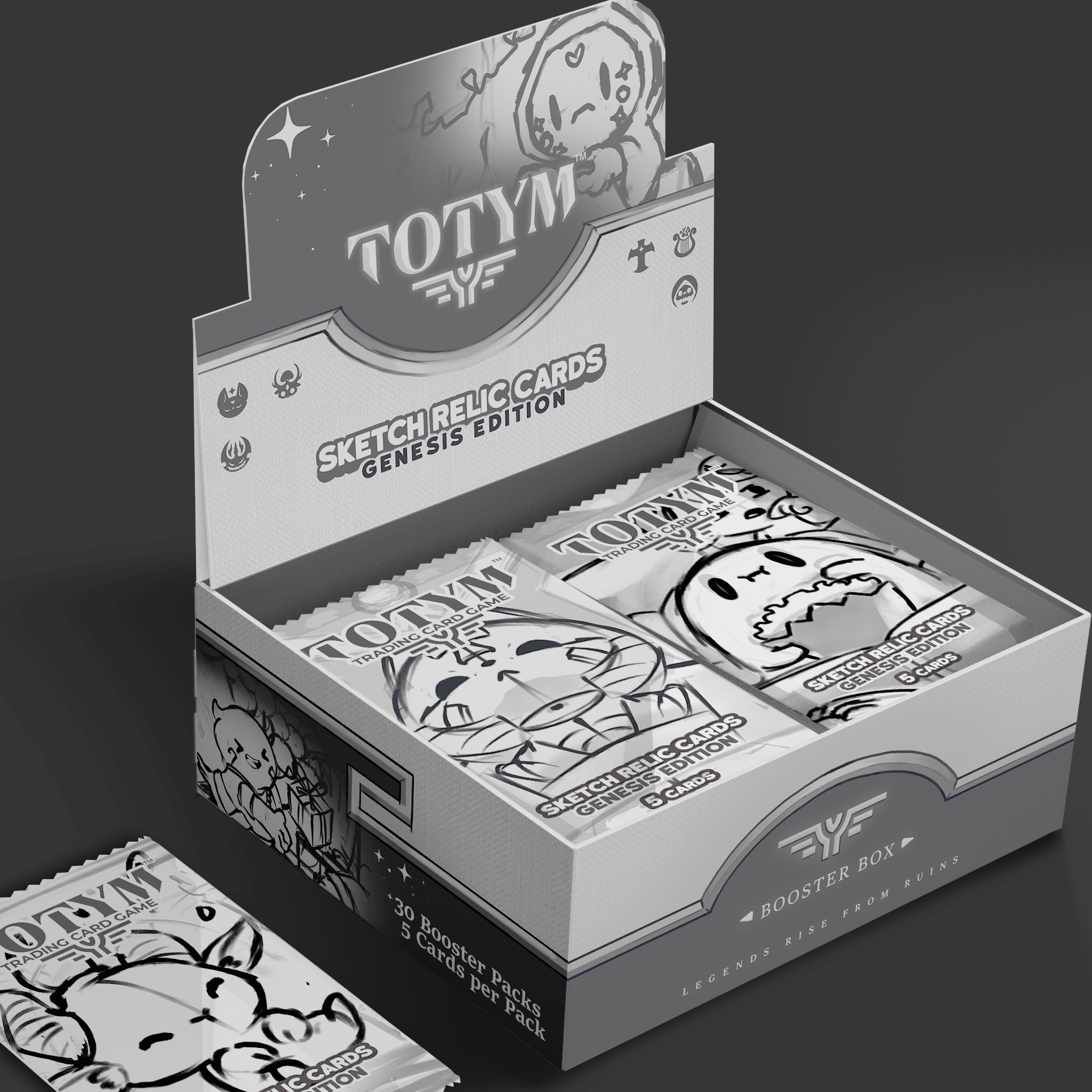
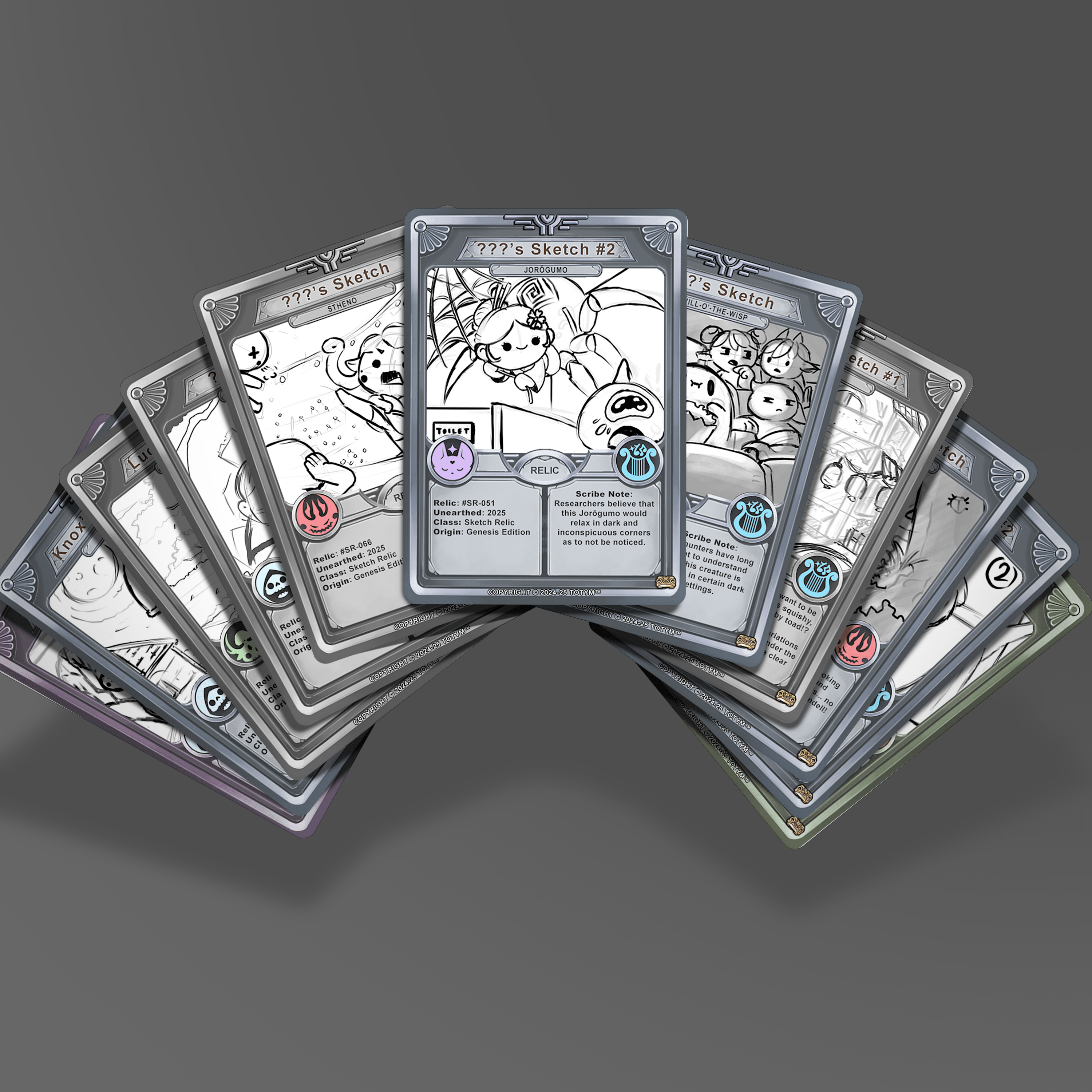
Relic Cards: Relic cards are promotional and collectible cards that are primarily collected outside of booster packs and starter decks and are not directly part of the main game. These cards can optionally be used in place of imposter cards, or for specific Relics that have Blessings and Immunities, can be used as playable creatures in the game.
2. Core Gameplay
Deck Construction
- 60-card deck
- Exactly 5 creature cards
- No duplicate creatures
- Maximum 3 of the same Minor Arcana tarot card (suits)
- Maximum 2 of the same Major Arcana tarot card (non-suits)
Game Modes
Traditional Mode
- Exactly 20 worship cards
- Exactly 30 tarot cards
- Exactly 5 imposter cards
- Maximum 15 Major Arcana tarot cards per deck
Chaos Mode
There are no restrictions on the distribution of worship, tarot, or imposter cards.
Setup
- Place your 5 creature cards into your Chapel.
- The remaining 55 cards become your Temple.
- Each player shuffles their Temple and Chapel. Other players may cut the Temple if desired.
- Each player chooses 1 creature to remove from their Chapel at random and place in front of them face down as their Active Creature.
- All players reveal their creature at the same time, and disclose their immunities and blessings
- Each player draws 5 cards
- Determine the starting player (flip a coin)
Turn Actions + Structure
Each turn consists of the following actions, taken in order unless otherwise specified.
-
Turn Draw Action
Draw 2 cards. -
Main Actions
The active player may optionally take the following actions, in any order:
- Blessing: Use the active creature blessing [1x per active creature]
- [1x] Tarot: Play 1 tarot card
-
[1x] Worship: Place 1 card into a totem face down to count as 1 worship
- Any card may be played as worship, regardless of type.
- Worship bluffing rules are explained later in the rulebook.
-
Lock Action (Optional, End of Turn Only)
The active player may attempt to lock 1 totem if all locking requirements are met. Locking requirements and outcomes are explained later in the rules.

3. Creatures
Active Creature
Each player has one active creature at a time. The active creature is placed in front of the player and totems are built to the left and right side of it.
Creatures remaining in the Chapel are inactive and cannot be interacted with.
Worship Requirements
Each creature card has:
- A left side with a worship symbol and number
- A right side with a worship symbol and number
These indicate the worship type and quantity required to form a perfect totem on each side.

Worship Clans
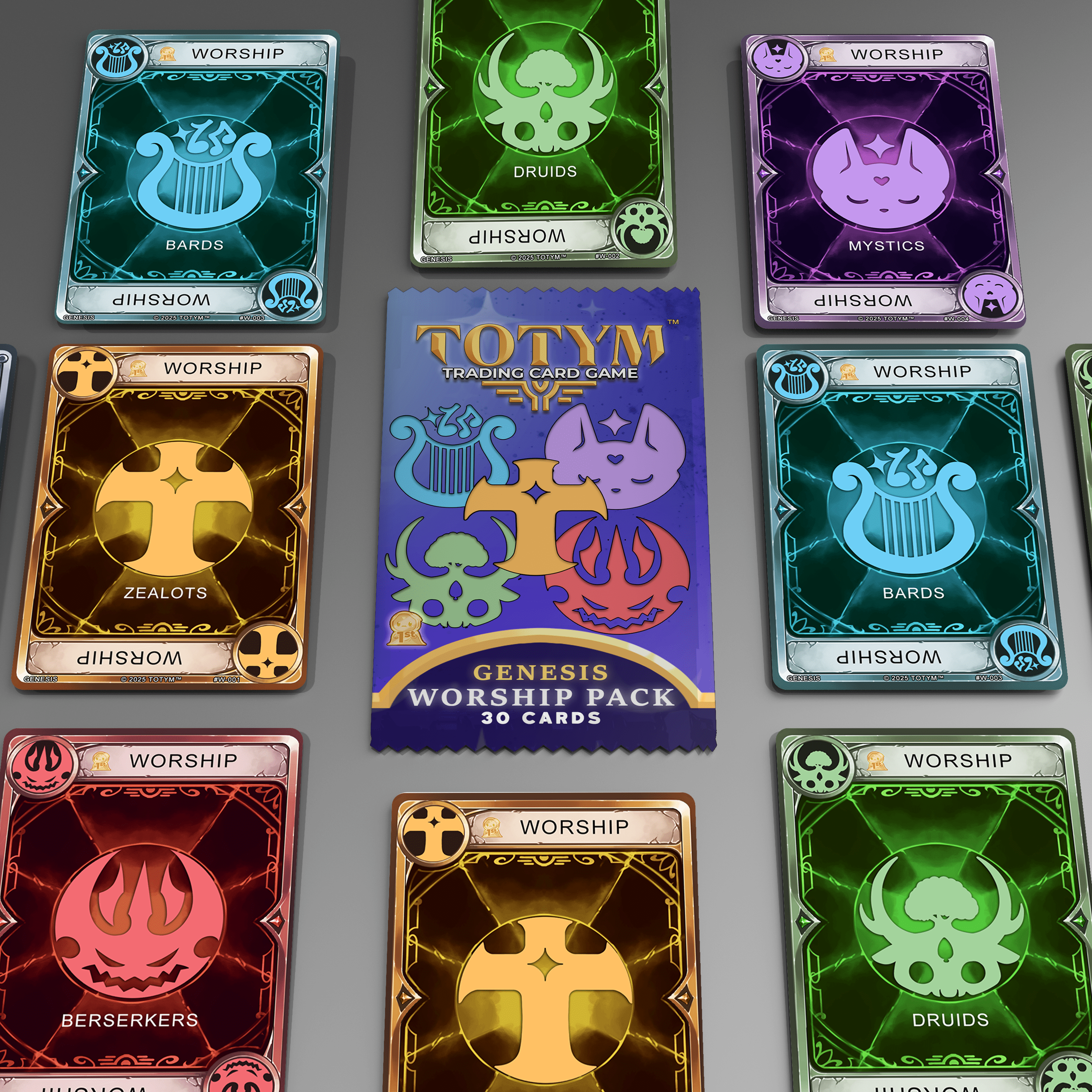
There are five worship clans:
- Berserkers
- Druids
- Bards
- Zealots
- Mystics
Worship symbols on creature cards correspond to these clans.

Creature Blessings
- Each creature has a blessing that may be used once per turn.
- Blessings are optional and are never forced.
- Blessings do not run out.
Creature Immunities
- Each creature has an immunity that prevents the player from being forced to perform specific actions.
- Immunities are optional and may be temporarily waived.
- The active player’s immunity does not apply to tarot cards that the active player chooses to play.
- If an immunity is not enforced at the time a tarot card resolves, it is considered waived (so remember to check your immunities often).
4. Totems, Worship, and Bluffing
Totems
Totems are built adjacent to the active creature:
- One to the left of the creature
- One to the right of the creature
The left and right sides are independent. A player may build both sides simultaneously.
A creature must have both left and right totems locked in order to ascend.

Totem Composition
A totem consists of:
- Face-up tarot cards
- Face-down cards played as worship
Tarot cards played face up resolve their effects normally. Tarot cards played face down are treated as worship cards and have no effect.
A card placed face down as worship:
- Counts as 1 worship
- Counts toward the total card count of the totem
- May be any card type (not just worship).
There is no maximum number of total cards that can be in a totem.
Worship Rules
- Each side of a creature requires an exact number of worship cards
- You may not place more worship cards than the required number.
- Once the worship requirement is met, additional cards added to the totem must be tarot cards. No further cards may be played as worship on that totem.
- Cards cannot be removed from a totem unless a tarot card or blessing allows for it.
Bluffing
Because any card may be placed face down as worship, worship may be real or bluffed. If a card placed as worship is not a real worship card, that worship is considered a bluff.
- Bluffed worship cards are not revealed until required by a rule or effect.
- When a face-down worship card is revealed, it remains face up
- If a revealed card is a bluffed worship card, it is still treated as a worship card occupying that slot
5. Locking Totems & Imposters
Requirements
To be eligible to lock, a totem must contain:
- The exact required number of worship cards, and
- A minimum of five total cards
This means that if a side requires three worship, at least two tarot cards must also be present.
Locking a Totem
When a player declares they are attempting to lock a totem, that totem is not revealed or fully locked immediately, as opponents may play an imposter card to challenge it.
Imposters
Opponents may play an imposter card to challenge a totem attempting to be locked.
- In a two-player game, the opponent may choose to play an imposter or pass.
- In a multiplayer game, the player to the left has the first opportunity to play an imposter. If they decline the opportunity, it moves clockwise until an imposter is played or all players have passed.
If no imposter is played, the totem becomes locked and is revealed.
Revealing the Totem
After a totem is formally locked or an imposter is played, it is revealed and evaluated as one of the following:
-
Perfect Totem
All worship cards are real and match the symbol on that side of the creature. -
Flawed Totem
All worship cards are real, but one or more do not match the required symbol. -
Defective Totem
The totem does not contain enough real worship cards to meet the required worship number because one or more of the cards are not worship cards.

Imposter Resolution
When an imposter is played, then it resolves as follows.
If the totem is Defective:
- The totem collapses, sending all cards in that totem to the Ruins.
- The imposter card is shuffled into its owner’s temple.
If the totem is Perfect or Flawed:
- The totem becomes locked.
- The imposter card is discarded.
- The active player whose totem is now locked chooses one:
- Collapse one unlocked totem controlled by that opponent, sending all cards in that totem to the Ruins.
- Force that opponent to discard their entire hand.
Failed imposter consequences above cannot be blocked or affected by creature immunities
Locked Totems
- Locked totems cannot be altered by any card or player.
6. Tarot Rules
Tarot Terminology
- Active Player: The player who is currently taking their turn
- Active Totem: A non-locked or empty totem
- Target: The individual player or players who are affected by a tarot card’s effects.
- Choice: When a tarot card presents multiple options separated by the | symbol, the active player selects one of the listed options to resolve.
- Pick: To choose the specified card or cards as instructed by a tarot card.
- “Win” a Coin Flip: To correctly guess the result of a coin flip.
Actions & Targets
Actions are performed by the target, except for:
- FLIP
- GAMBLE
- CURSE
These actions are performed by the active player unless otherwise specified.
The object of an action (hand, totem, temple, creature, ruins, or turn) always belongs to the target.
Target Types
- Self: The active player
- Opponent: Any one opponent chosen by the active player
- 2 Opponents: Any two opponents chosen by the active player
- Any: Any one player chosen by the active player (can choose yourself)
- All: All players
Targets must be declared before proceeding with the actions on the card.
Blocking
- Blocking prevents the target from performing that action type.
- Blocking does not prevent other players from performing that action type.
- Example: BLOCKING draw actions on your opponent does not stop them from playing a tarot card that makes you draw
- Blocking a target from performing an action type does not take away the number of actions they have. They still have that action available but just can’t execute it.
- Example: You have a creature blessing that allows you to add 1 tarot action if you forego 1 worship action. If you are blocked from a worship action, you can still utilize that blessing
- If tarot action is blocked, that means that no tarot cards can be played
- If worship action is blocked, that means that no cards can be played as worship cards
Arrange
ARRANGE allows the target to choose the order of affected cards.
Gamble
A gamble is an optional attempt to gain additional benefit from a tarot card.
- The previous action must have succeeded.
- If a gamble fails, all previously gained benefits are lost.
- If a number is listed, it is the maximum number of gambles allowed.
- If an infinity symbol is listed, gambles may be repeated any number of times.
- Targets do not perform the resulting actions until all gambles are complete.
- By default, the action and result are the same each time you gamble unless additional information is provided
- Example: If the original action was to flip a coin 2 times and get both correct to draw 5 cards, then if you gamble, you need to flip a coin 2 times again and get both correct again to bring the total draw from 5 to 10 cards. Then you can gamble again to bring it to 15 total, and again to 20
Curse
Only cards in an active / unlocked totem can be cursed.
If a player ends their turn with a cursed card in a totem, or attempts to lock a totem containing a cursed card, that totem collapses. Curses can be removed by discarding the card (when permitted to do so), or by switching the card to another active totem (when permitted to do so).
Tarot Persistence + Resolutions
-
Partial Prevention: If some effects are prevented due to blocking or immunity, all remaining effects still resolve.
- Example: If a tarot card attempts to block both worship actions and tarot actions, and the target is immune to blocked tarot actions, the tarot-action block is ignored. The worship-action block still applies.
-
Full Prevention: If all effects are prevented, the tarot card may still be played, but it resolves with no effect.
- Example: If a player is blocked from drawing cards and plays a tarot card that only instructs them to draw cards, the card may still be played but has no effect, since all of its effects are prevented.
- Tarot effects remain active even if a player ascends or is forced to discard.
- If multiple tarot cards change worship type, the most recently played effect takes priority.
- Negative effects override positive effects.
- Example: If your tarot card says you can draw 3 cards, but opponent’s tarot says that you are blocked from drawing cards, then you cannot draw
7. Ascension

A creature ascends when both its left and right totems are locked. When a creature ascends:
- The creature card is placed into the Ascended pile to count toward victory.
- The two locked totems are resolved as follows:
- Perfect totems are shuffled into their owner’s deck.
- Flawed totems are discarded to the Ruins.
- Defective totems are shuffled into their owner’s deck.
- The ascending player then:
- Discards their entire hand
- Chooses 1 new creature from their Chapel at random
- Draws 5 cards
Opponents keep their existing hands and totems; nothing changes for the opponents.
Ascension Rules
- Ascension cannot be blocked or prevented.
- Ascension is not affected by tarot cards or creature blessings.
- Ascended creatures cannot be reused or returned to play.
- Tarot effects that modify future actions remain active after ascension.
8. Miscellaneous Rules & Edge Cases
- Ruins are kept face down
- When a totem collapses, all cards go to the Ruins
- Cards from collapsed totems always go to the Ruins and cannot be altered with tarot or blessings
- Locked totems cannot be altered by any player or card
- Once a card is placed into a totem and released from the player’s hand, it cannot be taken back or switched to another totem unless the placement was invalid or your opponent is a nice person.
- Any player may "call clock" if another player is taking an unreasonable amount of time. A one-minute timer is used to complete the current action or decision.
- Once a face-down card in a totem is revealed, it remains face up. If the revealed card is not a worship card, it should remain clearly oriented or rotated to distinguish it from played tarot cards.
- There is no maximum hand size.
- Players must make reasonable and good faith accommodations to allow other players to see or know how many cards are in their hand upon request.
- Tarot effects that target more than one player resolve simultaneously. If the effect would cause all players to lose, they tie.
- Players do not mix cards with each other (ie tarot cards are never interpreted as playing your card onto someone else's totem, shuffling your hand into someone else's temple, etc)
Creature Swaps / Switching:
If an active creature is changed for any reason...
- The totems on the left and right sides remain in place.
- Tarot cards in those totems are not affected.
- For each side, if the new creature’s worship requirement is lower than the number of worship cards present, the excess worship cards on that side are immediately discarded to the Ruins by that player (the player whose totems are affected) until the requirement is met. The affected player can choose which of those worship cards get discarded.
- Locked totems are unaffected and stay locked, and retain their original status (ie a perfect locked totem remains perfect and locked even if the creature is switched).
- The tarot spell is considered to be played on the active creature that is out at the time of the tarot action. So creature swapping does not create a retroactive immunity to a prior tarot action.
9. Individual Card Clarifications
T-006 | The Hierophant
You can optionally skip your own turn draw on each turn as long as the card is still present on an active totem. If the card is removed or the totem gets locked, then the player can no longer choose to skip their turn draw.
T-075 | Page of Pentacles
The opponent must reveal their creatures to the active player so that the active player may choose which creature to switch to.
Changelog
v2.0 = 2026-07-22
- Added new card clarification: T-075 | Page of Pentacles
v1.9 = 2026-07-12
- Added clarity to misc rules section 8 for immunities after creature swap
v1.8 = 2026-07-10
- Improved clarity of max # of actions per turn and the use of a blessing when switching creatures
v1.7 = 2026-06-01
- Improved clarity and organization of creature swap rules
v1.6 = 2026-05-25
- Added individual card clarification
- Added curse removal clarification
v1.5 = 2026-05-09
- Added misc rule clarifying that players never mix their cards
- Added clarify on what cards can be cursed
v1.4 = 2026-05-08
- Multi-target tarot effect resolution order (Edge case)
- Active totem definition
- Clarified that failed imposter consequences cannot be blocked by creature immunities
v1.3 = 2026-04-22
- Creatures are chosen at random
- Clarified that locked totems remain locked and maintain their status even if the creature is switched
- Players can't purposefully hide how many cards they have if asked
v1.2 = 2026-03-17
- Added images throughout the rules to provide additional clarity
v1.1 = 2025-12-23:
- Clarified win conditions in Section 1
- Added shuffling your Temple into Section 5
- Minor formatting
- Removed conflicting rule from Blessings regarding order of play
- Improved clarity on creature immunity
- Minor clarifications in Section 8
- Clarifications in Section 9 regarding
- locking vs attempting to lock
- multiplayer imposter opportunities limited to 1 per opponent per totem lock
- collapsing a totem results in the cards going to the ruins
- Clarifications in Section 10 regarding
- Partial / Full Prevention of Tarot effects
- Rewrote Game Overview Section 1 to improve clarity and provide more information before the rule get into extreme detail in the following sections
- Combine sections 1 and 2 and 3 and then adjusted all of the other numbers
- Combined sections 4, 5, and 6 and then adjusted the other numbers